
Shoulder Rehab
An all-systems approach — profiling the athlete, not just the injury.
Book a Shoulder AssessmentAn all-systems approach — profiling the athlete, not just the injury.
Book a Shoulder Assessment
Shoulder injuries are among the most common and most debilitating injuries in contact and overhead sport — from the
rugby tackle and the GAA shoulder clash to the swimming stroke and the tennis serve. The athlete ultimately has to tolerate tackling, throwing,
falling, overhead loading and fatigue, and a rehabilitation plan must be built around that reality.
At Physio Tullamore we take an all-systems approach to shoulder rehabilitation: identify the exact structure involved, objectively profile the force the shoulder can produce and transfer, profile the whole athlete across movement, strength and workload, and rebuild towards return to performance — not simply return to play.
Objective Upper-Limb Force Profiling
Bringing the same objective testing standards to the shoulder that elite sport applies to the lower limb.
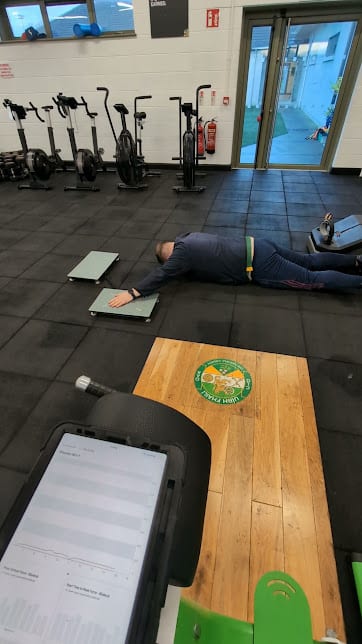
The Athletic Shoulder (ASH) Test is a novel upper-body isometric strength test performed prone, with the testing arm resting on force plates in three positions — I, Y and T — chosen to mimic the forces of the rugby tackle and overhead sport. It has shown excellent reliability in elite rugby players, making it a robust tool for quantifying the ability to produce and transfer force across the shoulder girdle.
The ASH Test gives us objective peak force and left–right asymmetry data at the angles the shoulder actually works in. Because it is a sub-maximal-effort-friendly isometric test, it can be used regularly on recovery days to monitor fatigue, guide return-to-contact and return-to-overhead decisions, and track rehabilitation progress — all measured using VALD performance technology.
Just as we would never return a sprinter to the pitch without Forcedeck or NordBord data, we never return a player to contact or overhead
sport without knowing what their shoulder can actually produce and transfer. ASH testing anchors every stage of the rehabilitation plan.
Structured, surgeon-aligned rehabilitation post surgery. There is an extensive list of surgeries that we look after but some of the common ones are below:
The Latarjet procedure is performed for recurrent shoulder instability and dislocation, particularly in collision and contact athletes. Our post-operative pathway respects the healing coracoid transfer and capsular repair: staged protection, gradual restoration of range, progressive rotator cuff and periscapular strengthening, then graded contact preparation before return to the field. Every milestone is measured, not guessed.
Rotator cuff repair demands a careful balance between protecting the tendon repair and preventing stiffness and deconditioning. We work from the surgeon's protocol: immobilisation and passive range early, progressing through active-assisted and resisted loading, scapular control and global strength — rebuilding a shoulder that can tolerate work, sport and overhead demand with confidence.
We coordinate the full surgical pathway — communicating with your consultant, following and progressing the post-operative protocol, and
using objective testing milestones so rehabilitation advances on evidence, not on the calendar alone.
From first assessment to return to performance — every stage measured, every progression earned.
We treat the structure — and the system around it. Each layer of the profile tells us where risk sits and what rehabilitation must address.
Rotator cuff problems are among the most common sources of shoulder pain in sport — from overload tendinopathy in overhead athletes to tears from tackles and falls. We never treat the cuff in isolation: cuff capacity, scapular control, thoracic mobility and training load are profiled together, because the cuff rarely fails in isolation. Where injection therapy is appropriate we coordinate it alongside — never instead of — a structured loading programme.
Acromioclavicular joint (ACJ) sprains are a hallmark of rugby, GAA and contact sport — typically from a direct blow to the point of the shoulder. We grade the sprain objectively, protect and progressively load the joint, and build the cuff and scapular strength the ACJ needs to tolerate contact again. For players eager to return to sport, injection therapy is an option we coordinate to settle pain and create the window to begin true rehabilitation.
ASH Test force profiles across the I, Y and T positions quantify how the shoulder produces and transfers force at sport-specific angles — alongside VALD performance technology for global strength. Left–right asymmetries and low force outputs in sport-specific positions tell us exactly where rehabilitation must target.
We assess comprehensive shoulder range — glenohumeral internal and external rotation, flexion and horizontal adduction — alongside thoracic extension and rotation and posterior chain mobility. Total rotational range and its side-to-side balance strongly influence cuff load and instability risk in overhead and contact sport.
The scapula is the platform the shoulder works from. Alterations in scapular position and dynamic control change subacromial space and cuff demand with every throw, tackle and press. We assess how the scapula and trunk behave in static positions and in motion — and build the control to hold up under fatigue.
Measured with VALD ForceDecks technology: how quickly force is produced, not just how much. The tackle and the fall happen in milliseconds — an athlete can be strong on the chart yet still unable to generate force fast enough to protect the shoulder in contact.
We build a picture of the whole athlete and develop all aspects of performance and robustness — not just the injured structure. Rehabilitation is used as an opportunity to return the player better, stronger and more resilient than before the injury.
We review global training workload and recovery between sessions — contact and throw counts, gym volume, acute:chronic load concepts and managing spikes. Most shoulder problems flare when load rises faster than the tissue and athlete have been prepared for; managing that curve is central to reducing recurrence.
Shoulder injuries are rarely one isolated issue. In our experience they are usually a combination of the factors above — structure involved, cuff capacity, scapular and trunk control, force production, movement quality, decision-making and workload management. Profiling across all systems allows us to target the true drivers of the injury rather than chasing symptoms, so players return to tackling, throwing, lifting and competing with confidence.
The same systems-based thinking underpins our wider sports rehabilitation work, including ACL management, hip and groin rehabilitation and the screening and testing behind our performance testing service.
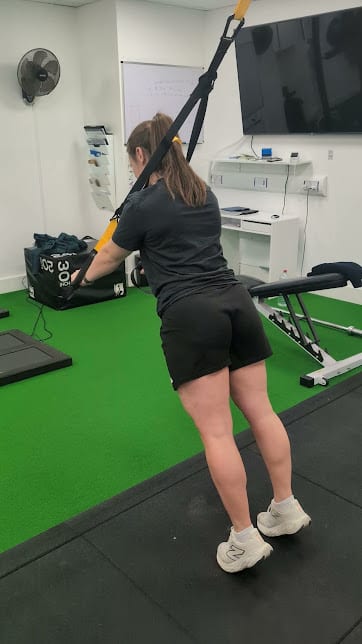
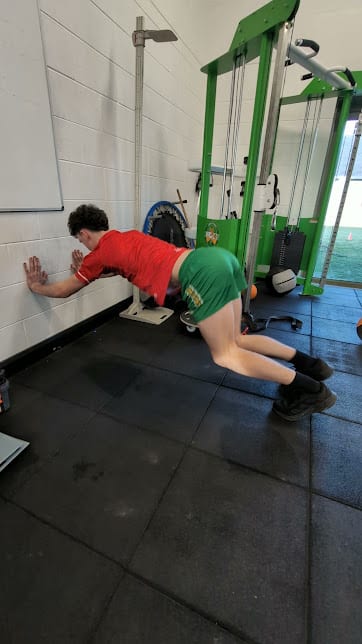
If you are carrying a shoulder injury, preparing for or recovering from shoulder surgery — or have been injured before and want to reduce your re-injury risk — we can help. Physio Tullamore provides physiotherapy and sports rehabilitation from our clinic in Tullamore, Co. Offaly, serving athletes across Offaly and the Midlands. Contact us to book a shoulder assessment and start rebuilding towards return to performance.
Book a Shoulder Assessment