
The practical takeaway: train the neck for strength, endurance, position control and tolerance to contact — but don't market it as "concussion-proofing." Alongside better coaching, better rule enforcement, safe tackling or heading technique, appropriate return-to-play decisions and a culture of early symptom reporting, it is a potentially useful strategy to reduce risk.
Why the neck matters
No single exercise or neck program has been proven to prevent concussions outright, though protecting against them is a major issue in contact, collision and high-speed sports. Strengthening the neck, including isometric neck holds, is a reasonable and useful part of overall physical preparation because it reliably improves neck strength. Whether that improvement directly reduces the incidence of concussion, however, remains uncertain.
Concussions occur when forces exerted on the head cause the brain to move within the skull. In sport, these forces can come from direct impact to the head, body contact that jars the head, falls, collisions with the ground, or accidental contact such as an elbow or a ball strike.
The purpose of the neck is to stabilise the head in relation to the torso. In theory, a stronger, more responsive neck could:
- Decrease the distance or speed of the head movement after contact.
- Improve the athlete's ability to hold head and neck position during impacts.
- Reduce linear and rotational acceleration of the head in certain impact situations.
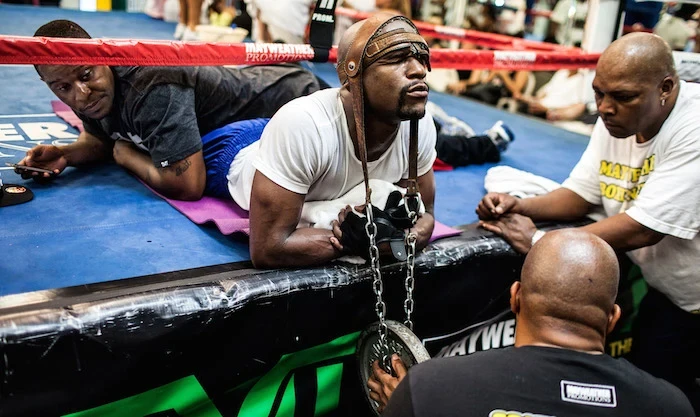
- Increase tolerance to the repeated demands of contact — tackling, rucking, scrummaging, wrestling, heading or physical contests.
There's biological sense to this theory. The head is effectively a load sitting on top of the cervical spine, and the neck musculature helps control it. If the neck muscles can generate force quickly and keep the head in a stable position, the head may move less during an impact.
But sport impacts happen extremely fast. An athlete might not see a collision coming, might be off balance, or might be hit at an odd angle. Strength alone cannot overcome the size, speed and direction of an external force. Neck work should therefore be regarded as an integral part of the preparation process — not as a form of protection.
What the evidence shows
Simply put, studies have shown that resistance training can improve neck strength. A systematic review and meta-analysis published in 2024 (Ivanić et al., 2024) found high-quality evidence that resistance training increases isometric neck strength, with a large overall effect size.
That is important, because isometric strength is very relevant to sport. Athletes are often required to resist an external force without excessive movement of the neck — bracing for contact, holding your shape in the scrum, resisting a tackle, or controlling the head in a grappling exchange.
The uncertainty starts with the question of whether stronger necks actually mean fewer concussions. That same 2024 review did not identify any included studies that directly assessed whether resistance-training programs reduced the incidence of sport-related concussion. It also did not find a statistically clear effect of resistance training on linear or rotational head acceleration, and the evidence quality for these outcomes was low to very low. Neck training clearly makes the neck stronger — but researchers can't yet say with confidence that it prevents concussions.
Previous reviews reached similar conclusions. A systematic review of adult amateur and professional athletes (Daly, Pearce & Ryan, 2021) found insufficient evidence to recommend neck-strengthening programs to reduce concussion or cervical-spine injury risk. This is not to say that neck training is useless — it means the research is not yet robust enough to prove a direct cause-and-effect relationship.
A useful distinction is causation versus association. Some observational studies have suggested that athletes with stronger necks might have lower odds of concussion. But stronger athletes may also differ in body size, training history, experience, technique, playing position, exposure to contact, anticipation skills and other factors — so the association doesn't show that the strength work itself caused the lower injury rate.
Does neck resistance training increase neck strength?
Yes — the evidence is strong, especially for isometric neck strength.
Does neck strengthening reduce head movement in all impacts?
Unclear — inconsistent results and limited evidence.
Does neck training prevent concussion?
Not proven. There is no direct, clear evidence that it decreases the incidence of concussion.
Should athletes perform reasonable neck work in training?
Yes, generally — when appropriate for the sport and individual, it can increase neck capacity and be one factor in reducing overall risk.
Isometric neck holds: the four-way hold
An isometric exercise is one in which muscular force is produced without any visible movement at the joint. For the neck, this usually means keeping your head neutral and gently pushing into your own hand, a wall, a towel, a band, or controlled resistance from a partner.
For beginners, self-resisted holds are generally the safest and easiest choice. The aim is not to stretch or force the head to move — the goal is to maintain a still head while building consistent tension.
Start position
Sit or stand tall, with your ribs relaxed, shoulders down and your head in a neutral position. Think "long neck," with the chin tucked in a bit — not poking forward. Do each of the following without moving the head:
Flexion hold
Put your palm on your forehead. Press the forehead into the hand. The hand resists enough to keep the head still.
Extension hold
Put your hands behind your head, on the back of the skull — not the neck. Push back gently, keeping your head in the neutral position.
Right lateral flexion hold
Place your right hand on the right side of your head, over your ear. Gently push the side of the head into the hand without letting the ear move toward the shoulder.
Left lateral flexion hold
Repeat on the left side, with your left hand on the left side of your head.
A good starting dose is 2–3 sets of 5–10 second holds in each direction at moderate effort. Rest 20–30 seconds between holds or directions. Slowly work up to 10–15 second holds, or increase the resistance while maintaining control of the neck position.


In coaching literature, moderate, steady pressure and a neutral cervical spine position are recommended, with no sudden or forcible effort. Isometric holds are usually done pain-free.
Sample progressions
Progress through the phases below — tap or click each phase to explore it.
Phase 1 — Positioning & low-load control
Use this phase for two to three weeks, especially if the athlete has never trained the neck directly.
- Chin-tuck against wall: 2–3 sets of 8–10 seconds.
- Four-way self-resisted isometrics: 2 × 5–8 seconds in each direction.
- Controlled cervical active range of motion: 5 comfortable repetitions of flexion, extension, rotation and side-bending.
- Scapular work such as rows, face pulls and shrugs, because the upper back and shoulder girdle help with good cervical posture.
The focus is clean control: no pain, no excessive jaw clenching, no shoulder lifting.
Phase 2 — Strength endurance
Once you're comfortable with basic control, build up time under tension.
- Four-way isometric holds: 3 × 10–15 seconds in each direction.
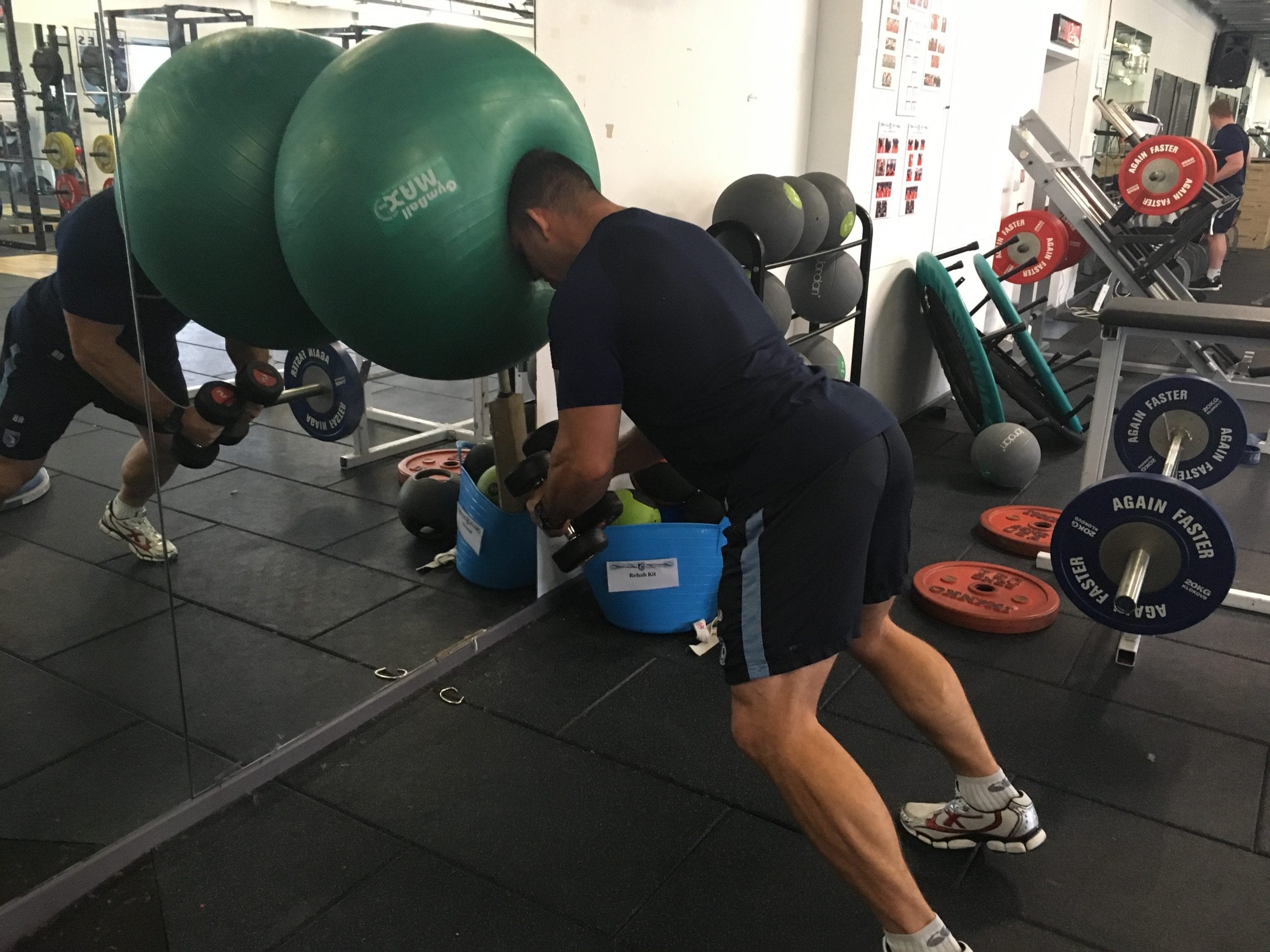
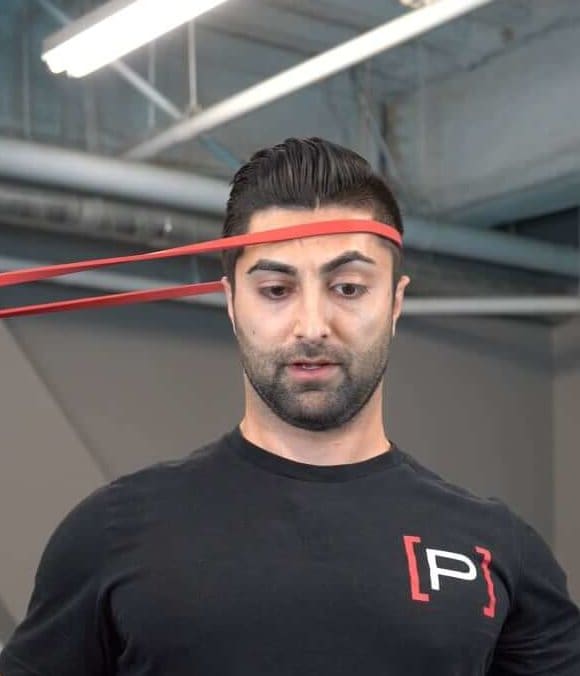
- Band-resisted isometric holds: 2–3 sets of 8–12 seconds.
- Partner-resisted holds: light, predictable resistance in four directions.
- Farmer's or suitcase carries: 2–4 controlled carries, keeping the head relaxed and neutral.
A 2023 neck warm-up study (Nagai et al., 2023) used short isometric contractions in flexion, extension and both lateral-flexion directions, progressing from around 50% to 75% and then 100% effort, along with movement and perturbation work. That is a warm-up style approach — not evidence that this particular protocol prevents concussion.
Phase 3 — Reactive stability
This phase is more sport-specific and should only be added once the athlete has good basic neck strength and is symptom-free.
- Physiotherapist perturbations: keep the head neutral while receiving light, short and unpredictable pushes from different directions.
- Band perturbations: create small changes in pull using a light band while the athlete maintains alignment.
- Sport-position isometrics: rugby athletes may use safe body positions relevant to contact preparation; grappling athletes may practise controlled postural holds specific to their sport.
The idea is not to shake, jerk or force the neck aggressively into end range — the objective is to activate quickly, but in a controlled manner, while staying aligned.
Before undertaking a neck exercise program
If you have current concussion symptoms, neck pain, radiating arm symptoms, numbness, tingling, dizziness, headaches provoked by neck movement, known cervical instability or a history of significant neck injury, do not begin a neck-strengthening program without clinical input.
- Stop and get assessed if neck exercises cause stiff or worsening neck pain.
- Stop and get assessed if you develop a new headache, dizziness, nausea or vision changes.
- Stop and get assessed if you notice pins and needles, weakness or altered sensation in the arm or hand.
- Stop and get assessed if exercises cause or aggravate concussion-type symptoms.
In the early stages, also avoid:
High-force manual resistance
Keep resistance light, predictable and pain-free until control is well established.
Heavy neck harness loading
Heavy loading may suit some experienced athletes, but it should be prescribed carefully and progressed based on training history, sport demands and neck symptom status.
Ballistic neck movements
No fast, jerky or explosive neck motions — quality of position comes first.
Uncontrolled bridging progressions
Advanced loaded positions should only be introduced under appropriate supervision and progression.
Conclusion
Isometric neck work is a practical, low-equipment way to build cervical strength, endurance and control. Research has clearly demonstrated that resistance training can strengthen the neck — but it is not yet clear whether this directly prevents sport-related concussion.
Neck strengthening should be part of a larger injury-risk reduction strategy, not a substitute for safer technique, coaching, rule changes, protective equipment where appropriate, or proper concussion recognition and management. For most athletes, a good starting point is four-way isometric holds two to three times a week, progressing slowly and remaining symptom-free.
If you'd like a neck program tailored to your sport, training history and symptom status, our team can assess and progress it safely with you — from baseline positioning right through to sport-specific reactive work.