
Pregnancy & Women's Health
Low Back Pain During Pregnancy
Why low back pain affects so many mums-to-be, and how it can be safely managed through every stage of pregnancy.
50–90%
of women develop lumbar low back symptoms at some stage during pregnancy
5–7 months
is when symptoms most commonly begin during pregnancy
21%
of women still experience pain for up to three years postpartum
Understanding the problem
What is pregnancy-related low back pain?
Pregnancy causes physiological and anatomical changes affecting the respiratory, cardiovascular, endocrine, renal and musculoskeletal systems (Aragão, 2019). Low back pain during pregnancy is defined as continuous lumbar or pelvic pain for more than one week while pregnant (Morgan, 2008) — and lumbo-pelvic pain is amongst the most common musculoskeletal disorders in pregnancy (Goossens et al., 2021).
From a biomechanical perspective, it is often associated with:
- Weight gain & posture changes — an anterior pelvic tilt and increased lumbar lordosis reduce support and increase discomfort
- Abdominal muscle stretching — as the uterus expands, the abdominals weaken, placing greater stress on the lower back
- Ligament laxity — increased progesterone, oestrogen and relaxin make surrounding structures less stable (Aragão, 2019)
Good news: research has shown that sleeping posture, mattress, previous number of children, weight gain or the baby's weight has no correlation with low back pain (Rungee, 1993).

Your treatment options
What tools do we have to manage LBP?
Low back pain can interfere with work and daily tasks such as cleaning, walking, lifting and driving while pregnant. Non-pharmacological treatments are usually the first intervention as they avoid negative effects on the foetus (Salazar-Méndez et al., 2024).
Non-pharmacological (first line)
- Soft tissue massage & tissue mobilisation
- Postural education
- 20–30 minutes of daily exercise, yoga & stretching
- Aquatic rehabilitation
- Kinesiology taping
- TENS (Salazar-Méndez et al., 2024)
Medication
- Paracetamol & NSAIDs are appropriate for mild to moderate pain
- NSAIDs should be avoided in the third trimester due to associated risks (Black et al., 2019)
- Always used alongside, never instead of, conservative care
Injections & surgery (last resort)
- Epidural steroid injections remain controversial due to limited safety research
- Ultrasound-guided sacroiliac injections can relieve pain rapidly
- Surgery is reserved for severe cases with neurological dysfunction when conservative management fails (Jung et al., 2026)
Trimester by trimester
Managing LBP through the stages of pregnancy
Management should be tailored to the stage of pregnancy, symptom severity, functional limitations and whether symptoms are mainly lumbar or pelvic girdle pain. Exercise, education and physiotherapy-based management are typically the foundation of conservative treatment (Liddle & Pennick, 2015).
First Trimester
0–13 weeksAnatomical changes are less pronounced this early, but LBP can still occur. Prioritise education, reducing aggravating factors and maintaining normal activity — in uncomplicated pregnancies, aerobic and strengthening exercise is considered safe if medical or obstetric contraindications are absent (Moise, 2026).
Education
Guidance on posture and load management, tailored to your day-to-day.
Gentle mobility
Keep joints moving with comfortable, low-strain mobility exercises.
Build strength
Strengthen the trunk, hip and pelvic muscles within your tolerance.
Stay active
Comfortable activity beats prolonged rest — every programme is individual.
Second Trimester
14–27 weeksSymptoms often become more noticeable as the uterus enlarges and your centre of mass shifts. Keep exercising as tolerated — a meta-analysis of 16 RCTs (1,885 participants) found structured exercise improved functional status as part of active management, rather than being a guaranteed pain cure (Kandru et al., 2023).
Keep moving
Mobility, pelvic and trunk control, and functional strengthening.
Support belts
May ease pain when symptoms interfere with daily life (Kalus et al., 2008) — an accessory, not a cure (Ho et al., 2009).
Kinesiology taping
A review of 7 RCTs (444 participants) reported improvements in pain and disability in the second and third trimesters (Xue et al., 2021).
Modify triggers
Adapt the activities and movements that reproduce your symptoms.
Third Trimester
28 weeks to birthThe focus shifts to maintaining comfortable movement and function rather than aggressively correcting pregnancy-related posture. Lower-impact options become especially useful — buoyancy in the pool takes the load off.
Go low-impact
Walking, stationary cycling and aquatic exercise as land-based activity gets harder.
Watch your position
ACOG advises avoiding prolonged supine exercise after ~20 weeks — the gravid uterus can compress major blood vessels (ACOG, 2020).
Manual therapy
The PROMOTE study (400 women) linked osteopathic treatment with improved pain and function — part of multimodal care, never a replacement (Hensel et al., 2015).
Layer your supports
Belts and taping can be combined with manual therapy from a qualified practitioner.
Know the limits
Contraindications & cautions
Treatment should always be guided by your individual presentation — some types of exercise may aggravate pelvic pain, especially around the pubic symphysis (Vleeming et al., 2008). Key cautions include:
- Skin irritation
- Skin lesions
- Increased pain
- Discomfort
- Poor tolerance
- Skin irritation
- Sensitivity to tape
- Severe respiratory disease
- Severe cardiac disease
- Severe cardiac arrhythmia
- Previous spinal injury/pathology, vertebral disease
- Placental abruption, vasa previa
- High-risk pregnancy, uncontrolled medical conditions or Type 1 diabetes
- Intrauterine growth restriction, active preterm labour
- Severe pre-eclampsia, cervical insufficiency
- Reported fetal heart-rate changes (Ho et al., 2009; Kalinowski & Krawulska, 2017; Meah, Davies & Davenport, 2020)
A closer look
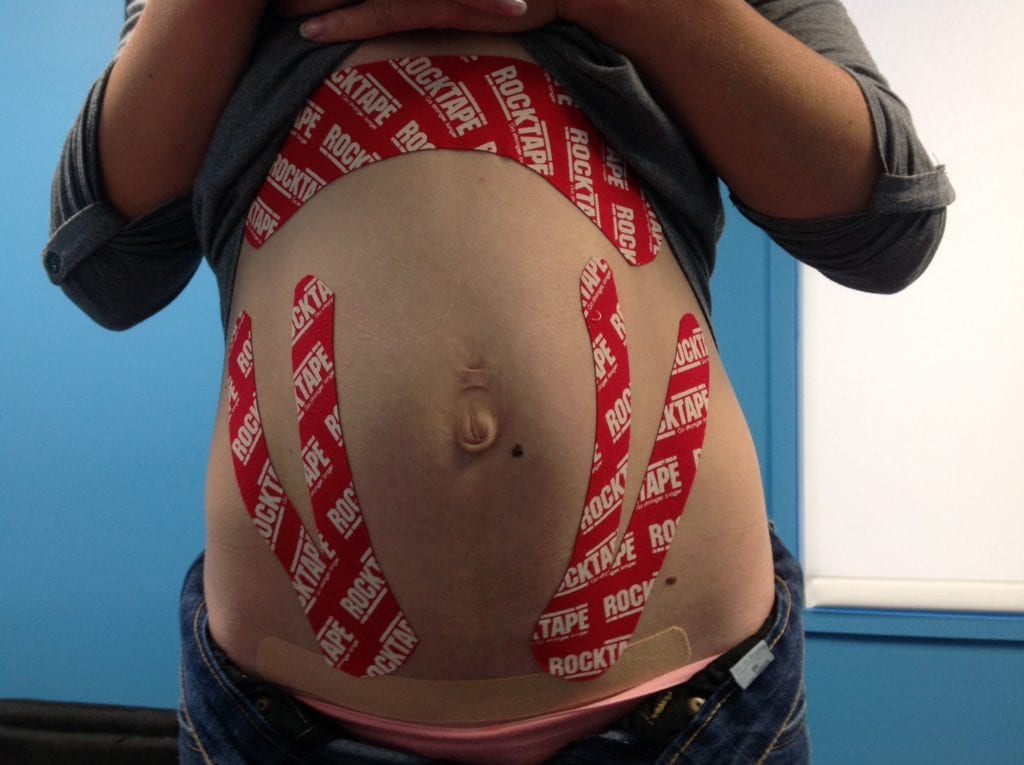
Pregnancy taping
Kinesiology taping (KT) involves applying adhesive tape to the skin to support and stabilise muscles and joints. It's non-invasive, and its elastic properties allow various levels of tension to target specific muscles based on your anatomy (Draper et al., 2019).
- Pain management — reduces pressure and improves blood circulation
- Muscle support — supports weak muscles and stimulates activation during movement
- Other benefits — localised swelling reduction, postural correction and joint stability (Kupczak et al., 2024)
The optimal time for tape to remain in place is five to ten days — there are no added benefits to leaving it on longer than 10 days (Salazar-Méndez et al., 2024).
Who can help?
Meet the team behind your care
Our clinicians have specific experience supporting women through pregnancy — from women's health physiotherapy to clinical Pilates-based rehab.

Women's Health
Deanna Kelly
Chartered Physiotherapist (CORU Registered) with extensive experience in the assessment and management of musculoskeletal injuries, with a particular interest in spinal conditions.
Read Deanna's Profile
Clinical Pilates
Aimee Bard
Chartered Physiotherapist (CORU Registered) combining strong clinical reasoning with modern, evidence-based treatment — including structured, Pilates-informed rehabilitation.
Read Aimee's Profile- References (18)
- Acog.org. (2020). Physical activity and exercise during pregnancy and the postpartum period.
- Aragão, F.F. de (2019). Pregnancy-related lumbosacral pain. Brazilian Journal of Pain, 2(2).
- Black, E. et al. (2019). Medication use and pain management in pregnancy: A critical review. Pain Practice, 19(8), pp.875–899.
- Draper, C. et al. (2019). Taping protocol for two presentations of pregnancy-related back pain: A case series. The Journal of the Canadian Chiropractic Association, 63(2), pp.111–118.
- Goossens, N. et al. (2021). Body perception disturbances in women with pregnancy-related lumbopelvic pain. BMC Pregnancy and Childbirth, 21(1).
- Hensel, K.L. et al. (2015). Pregnancy research on osteopathic manipulation optimizing treatment effects: The PROMOTE study. American Journal of Obstetrics and Gynecology, 212(1), pp.108.e1–108.e9.
- Ho, S.S.M. et al. (2009). Effectiveness of maternity support belts in reducing low back pain during pregnancy: A review. Journal of Clinical Nursing, 18(11), pp.1523–1532.
- Jung, H.S. et al. (2026). Epidemiology, risk factors, and management of pregnancy-related chronic back pain. Current Pain and Headache Reports, 30(1).
- Kalinowski, P. and Krawulska, A. (2017). Kinesio taping vs. placebo in reducing pregnancy-related low back pain: A cross-over study. Medical Science Monitor, 23, pp.6114–6120.
- Kalus, S.M., Kornman, L.H. and Quinlivan, J.A. (2008). Managing back pain in pregnancy using a support garment: A randomised trial. BJOG, 115(1), pp.68–75.
- Kandru, M. et al. (2023). Effects of conventional exercises on lower back pain and/or pelvic girdle pain in pregnancy: A systematic review and meta-analysis. Cureus, 15(7), p.e42010.
- Liddle, S.D. and Pennick, V. (2015). Interventions for preventing and treating low-back and pelvic pain during pregnancy. Cochrane Database of Systematic Reviews, (9).
- Meah, V.L., Davies, G.A. and Davenport, M.H. (2020). Why can't I exercise during pregnancy? British Journal of Sports Medicine, 54(23).
- Moise, K.J. (2026). Milestones in motion: Red cell alloimmunization. Obstetrics & Gynecology, 148(4), pp.427–431.
- Rungee, J.L. (1993). Low back pain during pregnancy. Orthopedics, 16(12), pp.1339–1344.
- Salazar-Méndez, J. et al. (2024). Optimal days of application of kinesiotaping for the treatment of lumbo-pelvic pain during pregnancy. Physiotherapy, 125, p.101418.
- Vleeming, A. et al. (2008). European guidelines for the diagnosis and treatment of pelvic girdle pain. European Spine Journal, 17(6), pp.794–819.
- Xue, X. et al. (2021). Effect of Kinesio taping on low back pain during pregnancy: A systematic review and meta-analysis. BMC Pregnancy and Childbirth, 21(1), p.712.